7JK 1
Recognised text
Text below was produced by optical character recognition and may contain errors. Check it against the original.
Radio amateurs in my life

lan Paterson VK2MW
RAOTC member No 810

The following is a ramble in the memory of VK3BJP and VK2CJP (my former callsigns), and

VK2MW. “There was always an amateur . . .”

oing a bit of reminiscing, as most of us Old
Dm== are wont to do these days, I realised that

for most of my life there has always been an
amateur radio operator somewhere . . .

I did what most of us did in the 1920s and 1930s. I
built crystal sets, mucked around with 201As, rheostats,
and B Batteries. Then came the ‘B Battery eliminator’,
and bigger speakers instead of gramophone horns.

Then on to Reinartz coils, a three valve receiver
(using a 27, a 47,and an 80 valves), and ‘Hi Fi’ with the
good old 2A3s in push-pull into the big Rola speaker
fastened to a 6 foot (1.83 m) Square ‘caneite’ baffle.
And then electric turntables, and searches for the best
fibre needles ... Ah, nostalgia!

There was talk of amateur radio. It was the
McClurcan era, the time for experimenting and
learning the ways of getting ‘on the air’.

World War II came along and sped things up a bit. I
was sent to Tamworth Signals Training Battalion to learn
Morse code and the basics of communication. I
encountered the 109 and 108 sets, the heliographs, the
signal lamps, the laying of Don 8 cable at high speed, and
the whole panoply of sending and receiving messages.

Advancement to Lieutenant, Officer in Charge of
36 Australian Wireless Task Section (AIF) followed.
The section was equipped with the glorious, but
terribly heavy, 133 transmitters, Kingsley receivers,
remote control units, 240 V AC power supplies, et al.

We soon dubbed ourselves the ‘Endless’ Task
Section, ready, we thought, to do anything. And this is
where the hand of the late, great John Heine VK3JF
(see below) and his training led us to do great things.

Among the personnel in the section were Aub
Miller, later to become VK2EEX, and Bert Harmer,

The author, lan Paterson VK2MW, in his radio ‘shack’.

ante = i ee ee =
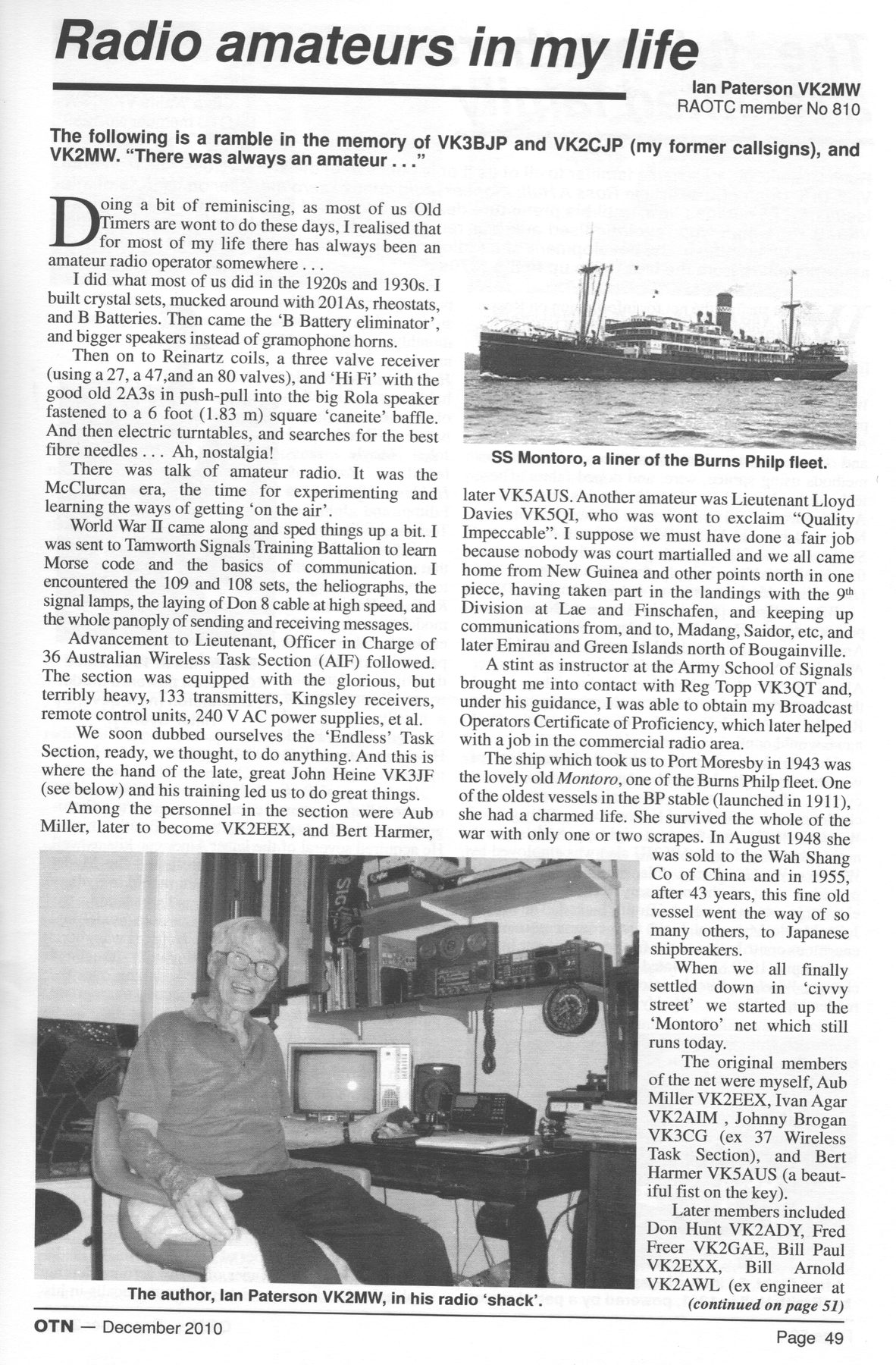
o, a liner of the Burns Philp fleet.

SS Montor

later VKSAUS. Another amateur was Lieutenant Lloyd
Davies VKSQI, who was wont to exclaim “Quality
Impeccable”. I suppose we must have done a fair job
because nobody was court martialled and we all came
home from New Guinea and other points north in one
piece, having taken part in the landings with the 9"
Division at Lae and Finschafen, and keeping up
communications from, and to, Madang, Saidor, etc, and
later Emirau and Green Islands north of Bougainville.

A stint as instructor at the Army School of Signals
brought me into contact with Reg Topp VK3QT and,
under his guidance, I was able to obtain my Broadcast
Operators Certificate of Proficiency, which later helped
with a job in the commercial radio area.

The ship which took us to Port Moresby in 1943 was
the lovely old Montoro, one of the Burns Philp fleet. One
of the oldest vessels in the BP stable (launched in 191 1),
she had a charmed life. She survived the whole of the
war with only one or two scrapes. In August 1948 she
was sold to the Wah Shang
Co of China and in 1955,
after 43 years, this fine old
vessel went the way of so
many others, to Japanese
shipbreakers.

When we all finally
settled down in ‘civvy
street’ we started up the
‘Montoro’ net which still
runs today.

The original members
of the net were myself, Aub
Miller VK2EEX, Ivan Agar
VK2AIM , Johnny Brogan
- VK3CG (ex 37 Wireless
Task Section), and Bert
Harmer VK5AUS (a beaut-
iful fist on the key).

Later members included
Don Hunt VK2ADY, Fred
Freer VK2GAE, Bill Paul
VK2EXX, Bill Arnold
VK2AWL (ex engineer at

(continued on page 51)

OTN — December 2010

Page 49