7LEpaper5
Recognised text
Text below was produced by optical character recognition and may contain errors. Check it against the original.
FORWARD TRANSMISSION FROM METEOR IONIZATION

22
2k
20
19 4
iB 4
17
lo |
15 4
4 |
13
12 4
Ta
10
9 4

NUMBER OF OCCURRENCES

—-—nNU hug a G

eo
34567 89 10
MINS. DURATION

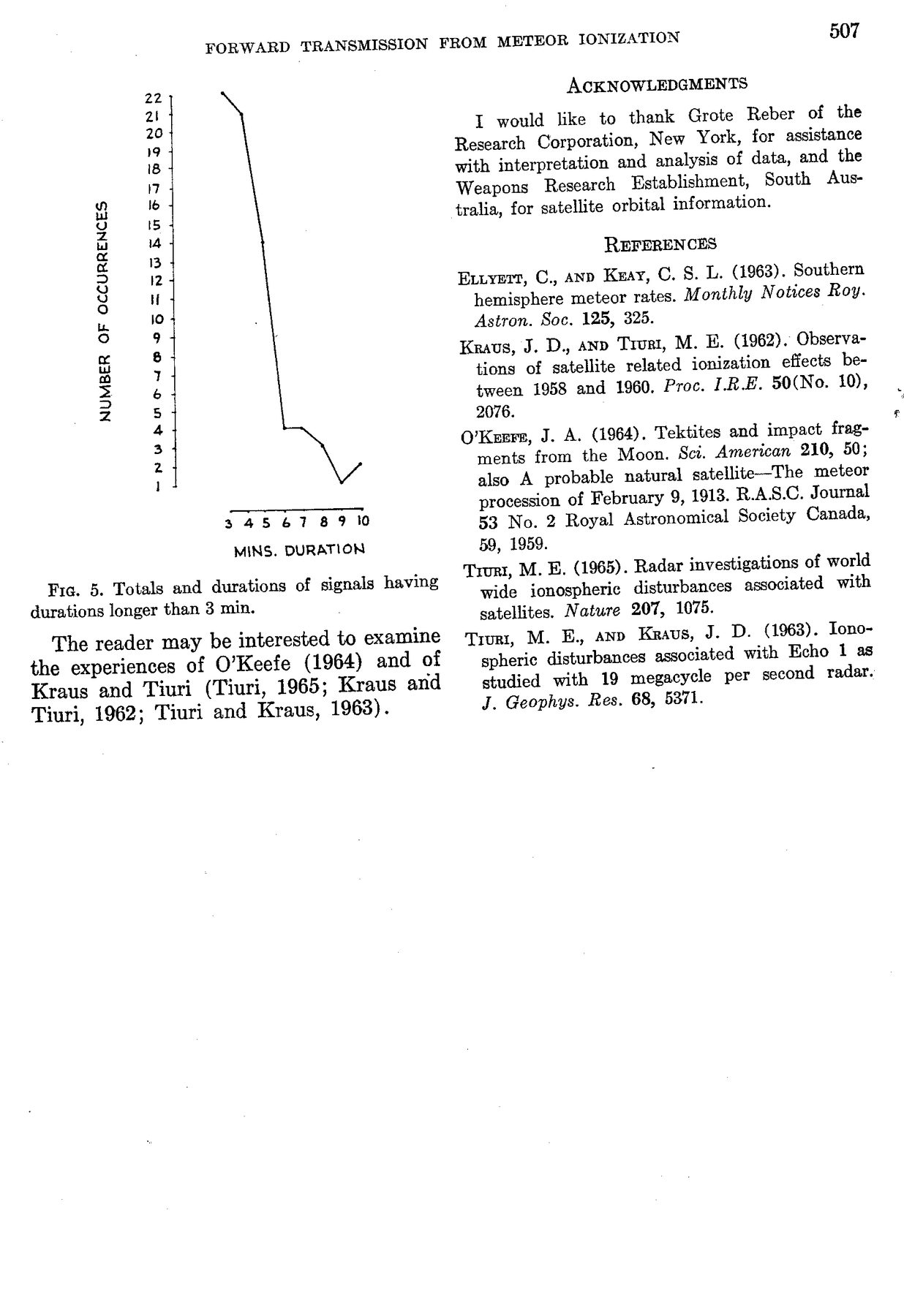
Fic. 5. Totals and durations of signals having
durations longer than 3 min.

The reader may be interested to examine
the experiences of O’Keefe (1964) and of
Kraus and Tiuri (Tiuri, 1965; Kraus and
Tiuri, 1962; Tiuri and Kraus, 1963).

507

ACKNOWLEDGMENTS

I would like to thank Grote Reber of the
Research Corporation, New York, for assistance
with interpretation and analysis of data, and the
Weapons Research Establishment, South Aus-
tralia, for satellite orbital information.

REFERENCES

Exiyerr, C., anp Keay, C. 8. L. (1963). Southern
hemisphere meteor rates. M onthly Notices Roy.
Astron. Soc, 125, 325.

Kraus, J. D., anp Trurt, M. E. (1962). Observa-
tions of satellite related ionization effects be-
tween 1958 and 1960. Proc. I.R.E. 50(No. 10),
2076.

O’Kzern, J. A. (1964). Tektites and impact frag-
ments from the Moon. Sci. American 210, 50;
also A probable natural satellite—The meteor
procession of February 9, 1913. R.AS.C. Journal
53 No. 2 Royal Astronomical Society Canada,
59, 1959.

Trurt, M. E. (1965). Radar investigations of world
wide ionospheric disturbances associated with
satellites. Nature 207, 1075.

Trort, M. E., anp Kravs, J. D. (1968). Iono-
spheric disturbances associated with Echo 1 as
studied with 19 megacycle per second radar.
J. Geophys. Res. 68, 5871.