Gillies 1
Recognised text
Text below was produced by optical character recognition and may contain errors. Check it against the original.
The Search for Mawson’s

Wireless Sets. - py Jon Gities

y search began in February,
Me at the launch of the
Mawson station Jubilee stamps,
at the Post Master Gallery, in
Melbourne, on the 50th anniversary of
the founding of Mawson.

In the gallery, was the wonderful
model of Mawson’s Hut, (erected at Cape
Denison, Commonwealth Bay in 1911),
made by Rod Mackenzie (Repstat 68).
Rod had received the plans of the hut,
as a gift from his daughter Jenny (Q92,
D95) and made the 1/12th scale model
from Baltic Pine.

In the corner of the workshop was a
scale model of the wireless which
attracted my attention. I asked several
museum people at the function if they
knew what had happened to the wireless
sets. No one knew.

Douglas Mawson’s ‘The Home Of
The Blizzard’ gave descriptions of the
installation of one of the sets at
Macquarie Island (Q), (call sign MQI)
and the subsequent attempts to erect an
antenna and communicate, while at
Cape Denison in 1912.

Mention is made in the book of the
erection of a new antenna by the crew of
the Aurora while they were waiting for
Mawson to return in 1913. On February
8 after Mawson returned, the ship
heard the station calling them back.
Macquarie Island was heard on Feb. 18
and two-way contact made on Feb. 20
briefly and for an.extended period on the
22nd. There is more mention of the
news from the outside world, the prob-
lem with maintaining the antennas and
the breakdown of Sydney Jeffreys.

The appendix of ‘The Home of the
Blizzard’ has an entry, Two complete
sets of Telefunken wireless apparatus
were purchased from The Australasian
Wireless Company (AWC). The motors
and dynamos were got from Buzzacott,
Sydney and the masts were built by
Saxton and Binns, Sydney. Manila and
tarred-hemp ropes were supplied on
generous terms by Melbourne firms
(chiefly Kinnear).’

‘Mawson’s Antarctic Diaries’ edited
by Fred and Eleanor Jacka, have a few
more details which I had not known
about., viz:

1 March, ‘Hodgeman gets space in
main hut for wireless gear.’

9 - 15 March, Wireless brought into
main hut.’

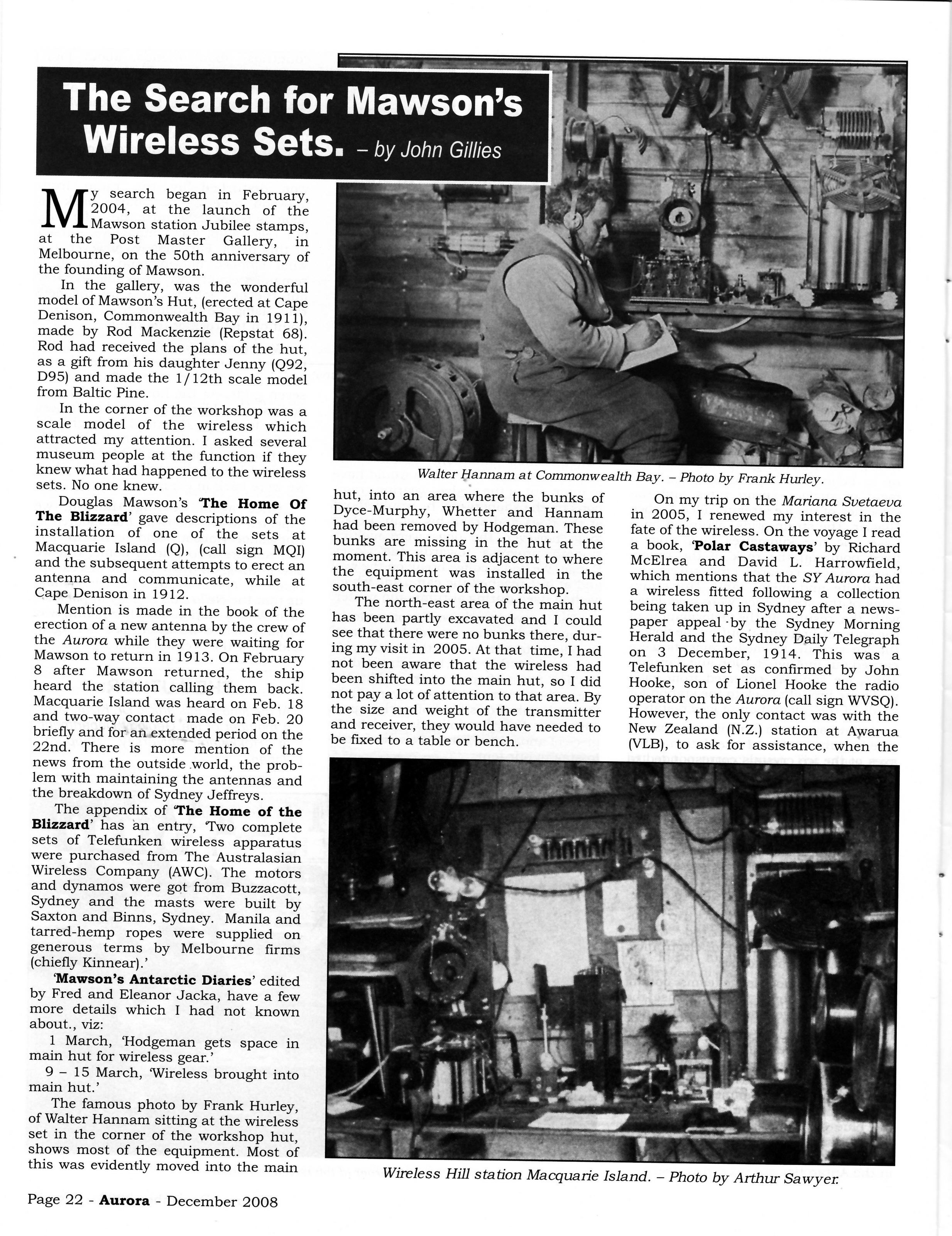
The famous photo by Frank Hurley,
of Walter Hannam sitting at the wireless
set in the corner of the workshop hut,
shows most of the equipment. Most of
this was evidently moved into the main

Page 22 - Aurora - December 2008

hut, into an area where the bunks of
Dyce-Murphy, Whetter and Hannam
had been removed by Hodgeman. These
bunks are missing in the hut at the
moment. This area is adjacent to where
the equipment was installed in the
south-east corner of the workshop.

The north-east area of the main hut
has been partly excavated and I could
see that there were no bunks there, dur-
ing my visit in 2005. At that time, I had
not been aware that the wireless had
been shifted into the main hut, so I did
not pay a lot of attention to that area. By
the size and weight of the transmitter
and receiver, they would have needed to
be fixed to a table or bench.

Walter Hannam at Commonwealth Bay. — Photo by Frank Hurley.

On my trip on the Mariana Svetaeva
in 2005, I renewed my interest in the
fate of the wireless. On the voyage I read
a book, ‘Polar Castaways’ by Richard
McElrea and David L. Harrowfield,
which mentions that the SY Aurora had
a wireless fitted following a collection
being taken up in Sydney after a news-
paper appeal -by the Sydney Morning
Herald and the Sydney Daily Telegraph
on 3 December, 1914. This was a
Telefunken set as confirmed by John
Hooke, son of Lionel Hooke the radio
operator on the Aurora (call sign WVSQ).
However, the only contact was with the
New Zealand (N.Z.) station at Awarua
(VLB), to ask for assistance, when the

nang

Bisinviis x

Wireless Hill station Macquarie Island. — Photo by Arthur Sawyer