Gillies 2
Recognised text
Text below was produced by optical character recognition and may contain errors. Check it against the original.
ae

Aurora had drifted out of the pack ice
and had limped almost back to New
Zealand, as reported by Kelly Tyler-
Lewis in her book, ‘The Lost Men’.

I communicated with Stephen
Haddelsey, author, of ‘Born Adventurer
Frank Bickerton’ and he wrote, “I can
say with a lot of confidence, that the
Telefunken set used on the Imperial
Trans-Antarctic Expedition was the
same as that used on, the Australasian
Antarctic Expedition (AAE).”

What happened to the set after that?
Some reading suggests it was removed
and cleaned, while the Aurora was being
repaired in New Zealand. At that time
there was the ruction about J.K. Davis
taking command of the Aurora instead of
Stenhouse. When Stenhouse was
sacked, Lionel Hooke was put off as
well. However, I could find no reference
to the wireless in Stenhouse’s papers for
this period. The only person to continue
on the Aurora was Aubrey Ninnis.

J.K. Davis wrote to his father, that
they had a new, more powerful, 2.5 kilo-
watt wireless set, from somewhere in
N..Z.. Davis had not been on the Aurora,
when there was a wireless transmitter
on board. There was only a receiver, on
the relief voyages he commanded in
1912 and, as far as I can find out, later
in 1913, when Mawson was finally
picked up and brought back to
Australia, in February, 1914.

While I was searching at the Scott
Polar Research Institute in Cambridge,
England, I ran the legs off Naomi
Boneham, the Archives Assistant there,
reading through material from that era.
I tried to find some mention of the sale
of the Aurora, when Shackleton had fin-
ished with it in 1917, to an American
company. There may be some informa-
tion in the papers of the lawyer they
used in New Zealand. Unfortunately the
Aurora disappeared near N.Z., on its way
to South America from Australia, in
1917 and is thought to have hit a
German mine.

Trying to find more information
about the wireless, I went to Adelaide
several times and was helped by Mark
Pharaoh to look at the records held in
the Mawson collection, at the South
Australian Museum. There were a num-
ber of interesting bits of correspondence
from Mawson, regarding the wireless.
He wrote to various companies request-
ing information and possible prices. In
an undated letter to Amalgamated
Wireless Australasia (AWA), he mentions
an offer of a wireless by Jesuits, but was
reluctant to take up the offer.

From previous research on AWA
papers in the Mitchell Library in Sydney,
while looking for information on the
repurchase of the wireless equipment, I
had read that a Father Shaw in Sydney,
was manufacturing wireless sets and
was in dispute with AWA for patent
infringements by copying Marconi
equipment.

A letter to Mawson from AWA, 27
March, 1911, said that wireless would
not work over that distance. Another let-
ter from AWA, 29 March, stated that, for
a wireless to work over that distance, it
would cost 20,000 pounds and that
small ‘sledge’ wireless sets were not
available.

Mr. Hugh Denison was one of the
original donors of one thousand pounds
to the expedition. He was the General
Manager of the Australasian Wireless
Company (AWC) and this company was
the agent for Telefunken wireless equip-
ment in Australia.

In a letter to the expedition secre-
tary, 13 Feb., 1912, Mr. Denison wrote
that the sets were sold for 650 pounds
each and AWC had offered to buy them
back, for half price, when they returned.
AWC was merged with AWA in 1913,
which complicated the search.

In February, 1912, no wireless con-
tact had been heard from the expedition
and the newspaper that had paid for the
exclusive news, was becoming agitated
at the lack of information. This rattled
the expedition secretary, Conrad Eitel,
who set out to acquire some new wire-
less gear and send it to Macquarie
Island. He sent letters to AWC saying
that their equipment was no good and
that there would be legal action against
them..

Father Shaw offered a wireless plant,
for 2000 pounds, that had been

The type of crystals available for the
receivers Mawson bought, is not listed
anywhere but in the stocktaking list pre-
pared by Charles Sandell (wireless oper-
ator and mechanic), when handing over
the wireless equipment to the Bureau of
Meteorology, a ‘detector potentiometer
type HB14 No. 3083’ is listed. This indi-
cated that a carborundum detector, was
at least one type used. In the Telefunken
catalogue it says that, ‘Carborundum
detectors had good sensitiveness (sensi-
tivity) with additional battery, great
overloads permissible and cannot get
out of order (mechanical alignment)
through vibration.’ The catalogue also
lists potentiometers for carborundum
detectors. However, the only catalogue
(from 1917) in the Berlin Museum
archives, does not have any numbers
that match the numbers in the stock-
taking list from Macquarie Island.

In the photo of Hannam, on the pre-
vious page, the panel in front of the
receiver switch beside him, looks like it
has at least two adjustable potentiome-
ters. The photograph, taken by Sawyer
on Macquarie Island, on page 22, shows
the equipment in a slightly different lay-
out, without the panel in front of
Hannam in the Hurley photo.

I had asked Allan Moore (M63, 65),
who wrote the series (published in
Aurora over a number of issues), ‘50
years of Australian Antarctic Radio’, if
he had any contacts, from when he had

installed on King Island. Eitel went

as far as paying a deposit for hiring | 5?

a ship to go to Macquarie Island.

Contact was eventually made
with Sydney when all the equipment
was installed in the huts built on
Wireless Hill. First contact from
Macquarie Island was with a ship
on 13 February. When contact was
made with Sydney, Eitel cancelled
the legal action and the hire of the
ship.

On 25 September, 1912,
Macquarie Island heard a singing
spark (the characteristic note of the
Telefunken spark transmitters) call
sign MAL (Mawson in Adelie Land),
which meant that the transmitting
set was working at Cape Denison.

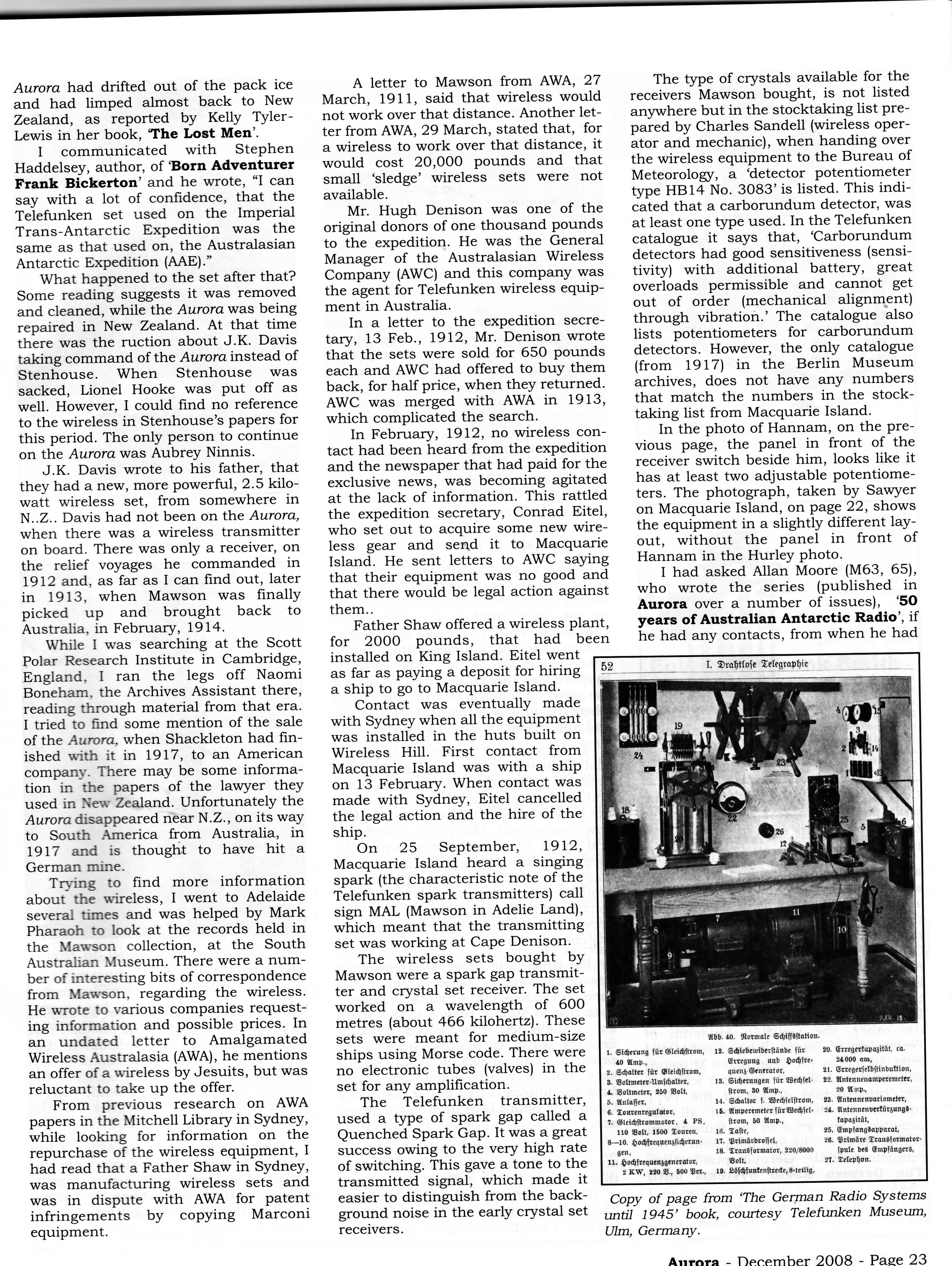
The wireless sets bought by
Mawson were a spark gap transmit-
ter and crystal set receiver. The set
worked on a wavelength of 600
metres (about 466 kilohertz). These
sets were meant for medium-size

I. Drahtloje Telegraphic

ALG. 40. Normale Sdhiffaitation.

ships using Morse code. There were |+

40 Ump.,

fic i 12. iderftinbde fiir 20. itat, ca.

: F b . 24 ;

no electronic tubes (valves) in the ] o esatter jae preter se

set for any amplification. 8. 13. Gi fiir Wechfel- 22. WAntennenamperemeter,

: 4 Boltmeter, 250 Bolt, ftrom, 30 Wmp., 20 Wnp.,
The Telefunken transmitter, | ». amtojer, 14. Séhaltor f. j 33.

used a type of spark gap called a 6. Tourenregulator, 15. Umperemeter fiir Wedfel- 24. Untennenvertiirgungs-
7. Gleidftcommotor, 4 PS, ftvom, 50 mp., fapagitat,

Quenched Spark Gap. It wasa great 110 Bolt, 1500 Tourer, 16. Tafte, 25, EmpfangSapparat,
8—10. * 1%. Prima 26. Brimarve Transformator-

success owing to the very high rate
of switching. This gave a tone to the
transmitted signal, which made it

gen,

11. Hod)frequenggenerator, Bolt,
2 KW, 220 B., 600 Ber.,

18. Tran8formator, 220/8000 fpule des Empfingers,

27. Telephon.

19. QH[hfuntenftrece, 8-tetlig,

easier to distinguish from the back-
ground noise in the early crystal set
receivers.

Copy of page from ‘The German Radio Systems
until 1945’ book, courtesy Telefunken Museum,
Ulm, Germany.

Aurora —- December 2008 - Page 23