Gillies7
Recognised text
Text below was produced by optical character recognition and may contain errors. Check it against the original.
After a trial winding a coil with
enamelled copper wire proved a failure, I
was given a roll of fabric-covered Litz
wire, used on the original coils, by a
member of the Historical Radio Society
of Australia.

I had joined the society a few months
earlier and there met a fellow, Ian
Malcolm, with whom I had worked in the
postmaster-general’s department (PMG)
in 1968, between my years at Mawson
and Casey. Ian had been a long-time
member of the society and introduced
me to Ian Johnstone, an avid collector of
old radio equipment. He supplied the
Litz wire and some of the old-type large
meters that were used for measuring the
voltage current and radio frequency cur-
rent.

The aerial coupling capacitor

Seen on the wall under the variome-
ter, this is part of the aerial matching
circuit. It is made from several large
glass test tubes with metal inside and
shim brass around the outside, to make
‘mini’ Leyden jars.

I was lent an original Telefunken
capacitor set by Ian Johnstone, to meas-
ure and copy. The original had shim tin
on the outside which I could not find, so
I used some shim brass. I coated the
brass with plumber’s solder, using a
torch and wiping the solder over the sur-
face, a small section at a time. This
made a tin-looking surface.

Morse key

The morse key was milled from some
brass bar to match one in a picture of a
Telefunken key.

Most radio operators had their own
favourite type of key, and usually took it
with them. As this wireless set keyed the
220 volts at close to 10 amps, the con-
tacts needed to be of large area.

Replica Telefunken morse key.

The bench and wall panel

The bench is made from one-inch-
thick tongue-and-groove pine boards,
again supplied by Brian Harvey. The
original was probably made with off-
cuts of the timber used to clad the build-
ing. The wall panelling is made from
Baltic pine lining boards, of the same
profile as those used to line the hut at
Commonwealth Bay.

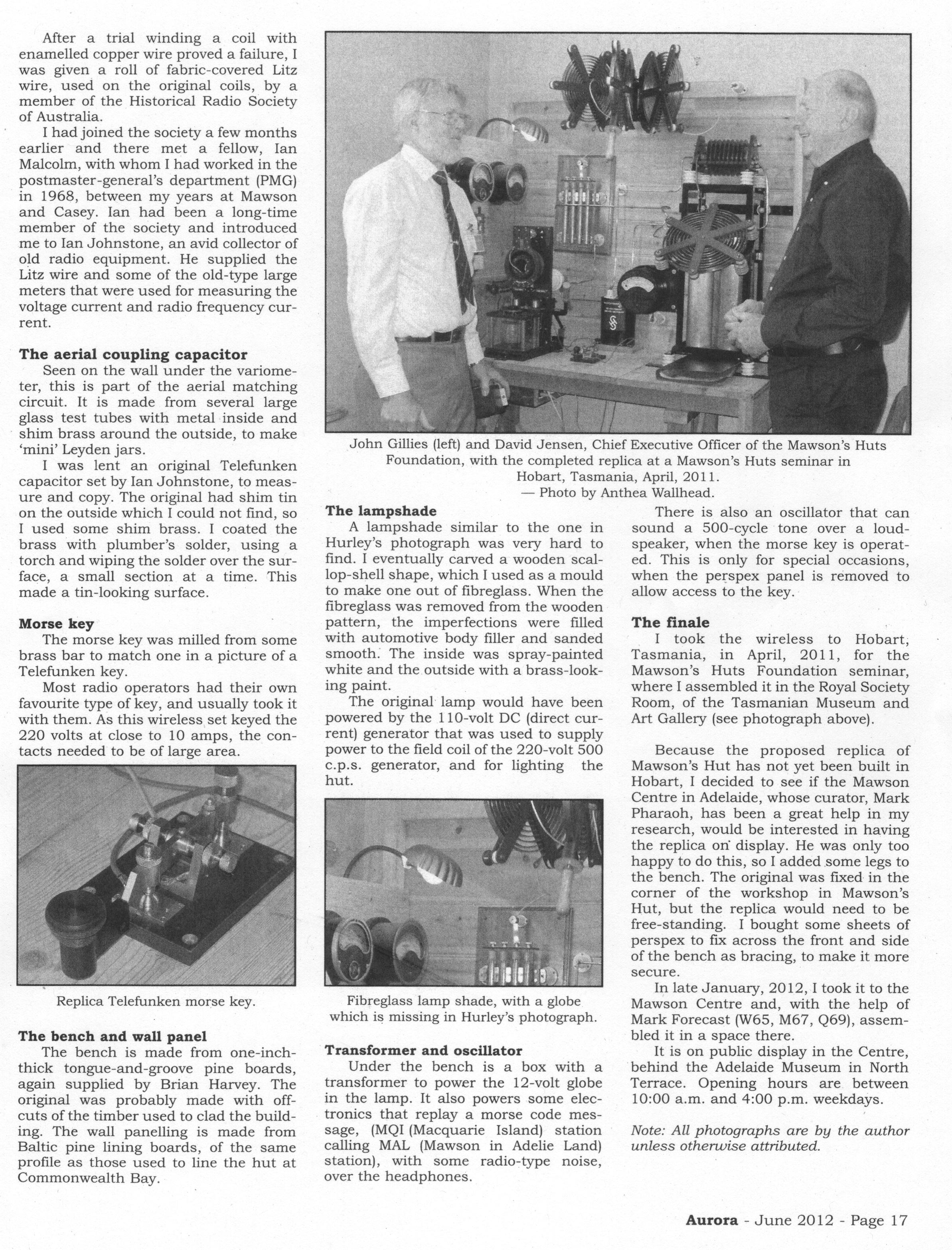
John Gillies (left) and David Jensen, Chief Executive Officer of the Mawson’s Huts

Foundation, with the completed replica at a Mawson’s Huts seminar in
Hobart, Tasmania, April, 2011.
— Photo by Anthea Wallhead.

The lampshade

A lampshade similar to the one in
Hurley’s photograph was very hard to
find. I eventually carved a wooden scal-
lop-shell shape, which I used as a mould
to make one out of fibreglass. When the
fibreglass was removed from the wooden
pattern, the imperfections were filled
with automotive body filler and sanded
smooth. The inside was spray-painted
white and the outside with a brass-look-
ing paint.

The original lamp would have been
powered by the 110-volt DC (direct cur-
rent) generator that was used to supply
power to the field coil of the 220-volt 500
c.p.s. generator, and for lighting the
hut.

Fibreglass lamp shade, with a globe
which is missing in Hurley’s photograph.

Transformer and oscillator

Under the bench is a box with a
transformer to power the 12-volt globe
in the lamp. It also powers some elec-
tronics that replay a morse code mes-
sage, (MQI (Macquarie Island) station
calling MAL (Mawson in Adelie Land)
station), with some radio-type noise,
over the headphones.

There is also an oscillator that can
sound a 500-cycle tone over a loud-
speaker, when the morse key is operat-
ed. This is only for special occasions,
when the perspex panel is removed to
allow access to the key.

The finale 5
I took the wireless to Hobart;
Tasmania, in April, 2011, for the

Mawson’s Huts Foundation seminar,
where I assembled it in the Royal Society
Room, of the Tasmanian Museum and
Art Gallery (see photograph above).

Because the proposed replica of
Mawson’s Hut has not yet been built in
Hobart, I decided to see if the Mawson
Centre in Adelaide, whose curator, Mark
Pharaoh, has been a great help in my
research, would be interested in having
the replica on display. He was only too
happy to do this, so I added some legs to
the bench. The original was fixed in the
corner of the workshop in Mawson’s
Hut, but the replica would need to be
free-standing. I bought some sheets of
perspex to fix across the front and side
of the bench as bracing, to make it more
secure.

In late January, 2012, I took it to the
Mawson Centre and, with the help of
Mark Forecast (W65, M67, Q69), assem-
bled it in a space there.

It is on public display in the Centre,
behind the Adelaide Museum in North
Terrace. Opening hours are between
10:00 a.m. and 4:00 p.m. weekdays.

Note: All photographs are by the author
unless otherwise attributed.

Aurora - June 2012 - Page 17