Making the most of your receiver Eddystone Stratton VK7AG 0007
Recognised text
Text below was produced by optical character recognition and may contain errors. Check it against the original.
PROPAGATION.

Many users of Eddystone receivers will already be familiar with the propa-
gation conditions which affect shortwave reception. During daylight in mid-
summer, the highest frequencies can generally be relied on to produce good
results. For example, the || metre B.B.C. transmission has good entertainment
value, and conditions on the 28 Mc/s amateur band permit contacts to be made
over long distances. At night, signals on the higher frequencies fade out. . This

effect is more pronounced during the winter months, when lower frequencies”

give the better results.

Conditions also vary over what is known as ‘‘the eleven year sun-spot cycle’.
During 1948, long distance communication has been possible on 30 Mc/s and even
higher frequencies but, during the next few years, a gradual decline will be noticed
in the highest useful frequencies.

So if, on a winter’s evening, you find little or nothing on Range |, you will
appreciate that it is quite likely due to natural phenomena.

AERIALS ON BOARD SHIP.

Circumstances vary greatly on board ship, and the only advice generally
applicable is to place the aerial as high as possible and well clear of other wires
and metal objects. The insulated wire(s) forming the aerial proper must not
be allowed to rub against anything—as might possibly happen in a high wind—
or severe noises may mar reception.

Good results are obtainable from the usual single wire aerial, which may
be partly horizontal and partly vertical, or entirely vertical. It should be well
insulated, both at points of support and where it passes through a deck or
partition. The longer the aerial, in general the better the results, particularly
on the lower frequencies and on the medium wave broadcast band. But it will
be found that excellent results are obtainable, even with quite a short aerial,
on the higher frequencies.

That portion of the aerial near the deck is liable to pick up interference
from nearby electrical wiring, and there is also the problem of arranging adequate
insulation at the lead-in point. Both these disadvantages can be overcome by
the use of a doublet type of aerial, details of which are given elsewhere. The
Eddystone Cat. No. 731 Aerial is of this type, and includes aerial wire, insulators
and fifty feet of special low impedance feeder, all ready for putting into use
immediately, with the minimum of trouble. In some cases, fifty feet of feeder
may not be enough, when the Cat. No. 731/I, with one hundred feet of feeder,
will be suitable.

It should be appreciated that, by employing a longer length of feeder, it
will often be possible to site the aerial proper in a better location. The longer
length of feeder has practically no effect on reception. Where a surplus exists,
there is no need to cut the feeder—it can be made up into a neat roll and stowed
away behind the receiver.

The feeder wires are buried in insulating material, and no further insulation

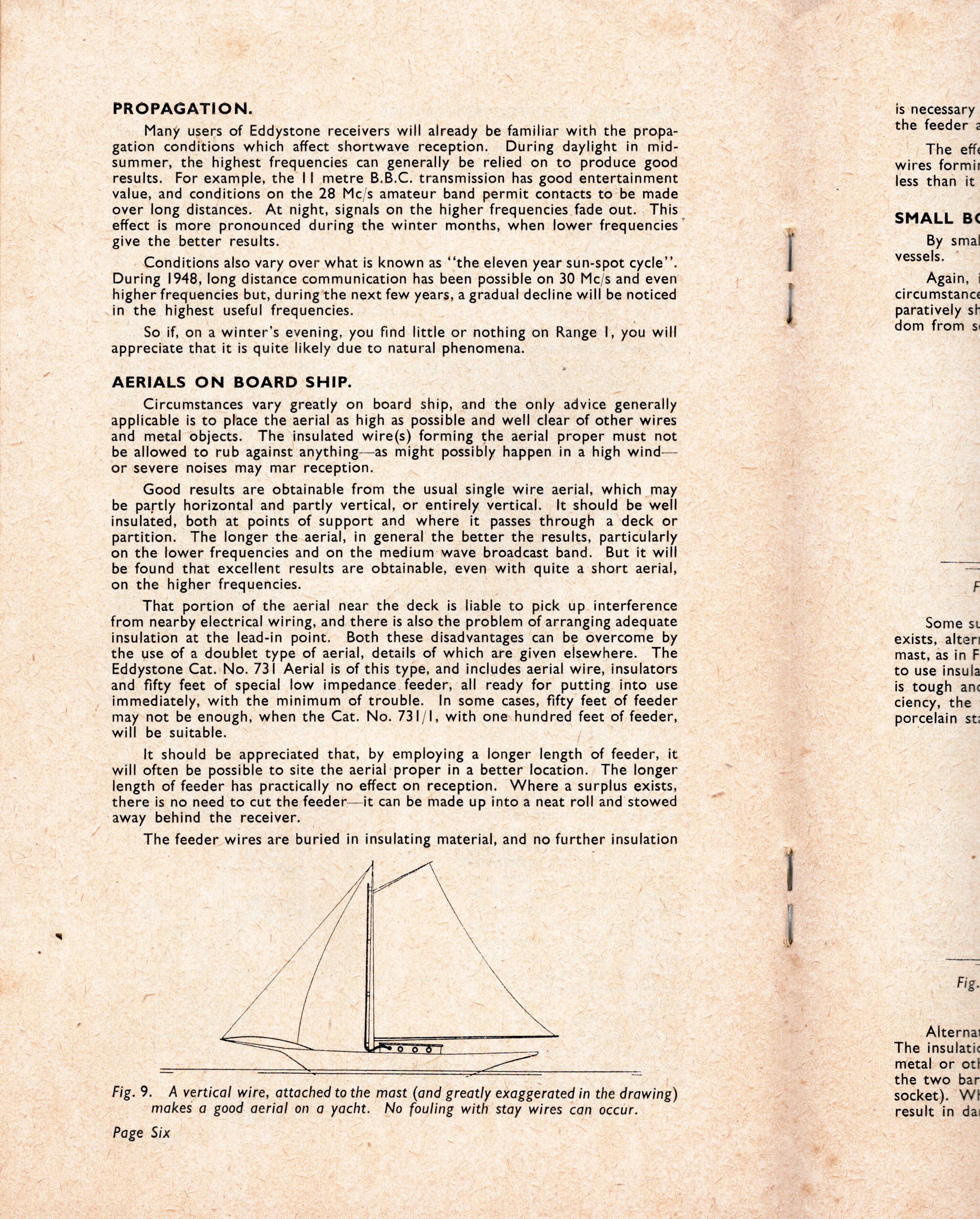
Fig.9. A vertical wire, attached to the mast (and greatly exaggerated in the drawing)
makes a good aerial on a yacht. No fouling with stay wires can occur.

Page Six

ol

is necessary
the feeder <

The effe
wires formii
less than it

SMALL B¢

By smal
vessels.

Again, |
circumstance
paratively sh
dom from si

Some st
exists, alter:
mast, as in F
to use insula
is tough anc
ciency, the
porcelain st:

Fig.

Alternat
The insulatic
metal or ot!
the two bar
socket). W!
result in da