Making the most of your receiver Eddystone Stratton VK7AG 0010
Recognised text
Text below was produced by optical character recognition and may contain errors. Check it against the original.
ISCHARGES.

ienced with light-
static electricity,
ts are likely when
receivers. With
r), a condenser is
n highly insulated
ie.
a greater liability
tricity.
protection against
consists of carbon
j in a sealed glass
the Ediswan Gas
irges of more than

=
rect one electrode

andbook or folder
that proper time
ains in order that
>»
panel is correctly
s in any way con-
ains between 100
of a value below
; are between 200
whichever socket
is very important,
supply, to ensure
D.C. no dial light

as plug is inserted.
ort of hum occurs
se the mains plug
9roduction will be
et to D.C. mains,
, again, the mains
the receiver.

nance of a battery
the batteries used
sr attention, both
the best possible

orms. When the
[an see.at a glance
ged, the positive
light grey colour.
becomes a lighter
iarge the cell.

=n not so easy to
It meter is always
on of the state of
Its on load should
hould be charged.
>r is to use what
this instrument a
ding a reading of

“as standard in Eddystone receivers

1.15 is obtained, or greater, everything is in order, but should the value be
below this, then charging is necessary. A fully charged cell will normally show
a specific gravity of approximately 1.25.

There are two important points to watch to ensure maximum life from the
battery. One is that the level of the acid is maintained to the maker’s mark,
where visible, but in any case, always above the top edge of the interior plates.
The second point is not to allow the accumulator to become discharged to any
great degree or to leave it in a discharged condition for any length of time. As
soon as you become aware that charging is necessary, steps should be taken to
put the battery on charge as quickly as possible.

Eddystone battery receivers are provided with a length of cable adequate
for all normal requirements. Should, however, in exceptional cases, an additional
length of cable be found necessary, this cable should be of heavy gauge wire to
minimise voltage drop.

The top of the accumulator should be kept clean, the terminals well greased
with ordinary vaseline, and the filter-vent kept screwed down tight except when
the accumulator is being charged. It is important to loosen these vents whilst
the cell is being charged to allow the escape of gas formed during the charging
process. ;

Normally, when the level of acid drops, it will only be necessary to add
distilled water. Care is required during this operation to prevent the spillage
of any acid, as it will have a deleterious effect on any material with which it
comes into contact.

From time to time, it is advisable to wash out the cells of the accumulator
in order to remove the deposit at the bottom. This, if allowed to increase,
might result in a partial short circuit of the cell. A sign of this is that the accumu-
lator will not hold its charge properly, or that one cell always shows a much
lower voltage than the others.

This washing out process is best entrusted to someone used to the job,
such as a garage or wireless service station. Before emptying the cells they
should be in a fully charged condition, and when filling with new acid, the specific
gravity of the latter should be approximately 1.25.

An accumulator should always be kept in as cool a place as possible, and
not exposed to direct sunlight, which is likely to have a bad effect on the chemicals
inside the cells.

LOUDSPEAKERS AND TELEPHONES.

Because compactness is desirable, a loudspeaker is fitted internally in some
Eddystone receivers, but in others, the individual is free to choose a speaker
to suit’ personal requirements.

An output transformer is fitted

of all types—communications and
broadcast. The secondary winding
is brought. out to terminals or
sockets, and a loud-speaker, connect-
ed to the latter, should have an’
impedance of between 2 and.3 ohms.
No matching transformer is required
with an external loudspeaker.

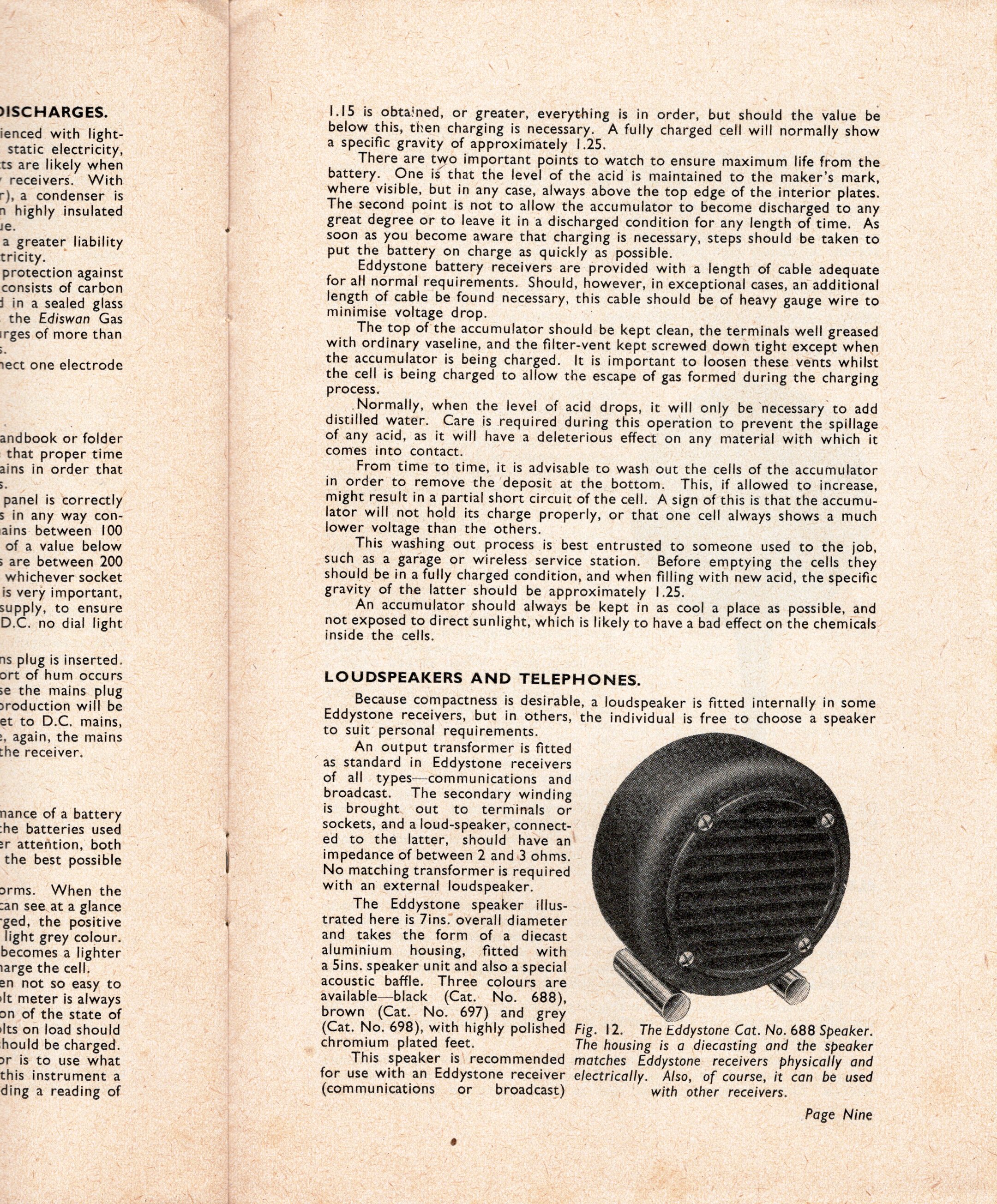
The Eddystone speaker illus-
trated here is Zins. overall diameter
and takes the form of a diecast
aluminium housing, fitted with
a Sins. speaker unit and also a special
acoustic baffle. Three colours are
available—black (Cat. No. 688),
brown (Cat. No. 697) and grey
(Cat. No. 698), with highly polished Fig. 12. The Eddystone Cat. No. 688 Speaker.
chromium plated feet. The housing is a diecasting and the speaker

This speaker is recommended matches Eddystone receivers physically and
for use with an Eddystone receiver electrically. Also, of course, it can be used
(communications or broadcast) with other receivers.

Page Nine