Making the most of your receiver Eddystone Stratton VK7AG 0011
Recognised text
Text below was produced by optical character recognition and may contain errors. Check it against the original.
which it will match by correct choice of colour physically and electrically.

When it is desired to use an extension speaker, this should be connected
to the terminals on the receiver, either in place of the local speaker or, when
simultaneous operation is required, in parallel with it. In the latter case, there
may be a slight mismatch, but it will have negligible effect.

An important point is the length of wire necessary to connect the extension
speaker to the receiver. Where the run is short, ordinary insulated bell wire
is suitable, but it is desirable to use a heavier gauge of wire for a longish run, to
prevent an unduly high proportion of the audio power being wasted in the
wiring, with a consequent reduction of volume in the extension speaker.

Eddystone communications receivers are fitted with jacks for the insertion
of a telephone plug. The telephones should be of the high impedance type,
having a resistance of 2000 or 4000 ohms. A number of good makes are available.
Crystal telephones are also suitable.

Sometimes, the listener may have on hand low impedance telephones,
having a resistance of about 120 ohms, or
moving coil telephones (about 50 ohms).
In such cases, the better procedure is to
connect them to the loudspeaker output
terminals. This advice may seem to con-
flict. with that previously given about
using a speaker of 3 ohms impedance, but
this is not actually the case. Power
is required to work a loudspeaker, and
matching conditions are important.

‘Telephones take very little power, but
require an adequate voltage and this is
provided at the loudspeaker terminals,
for telephones of the low impedance
type.

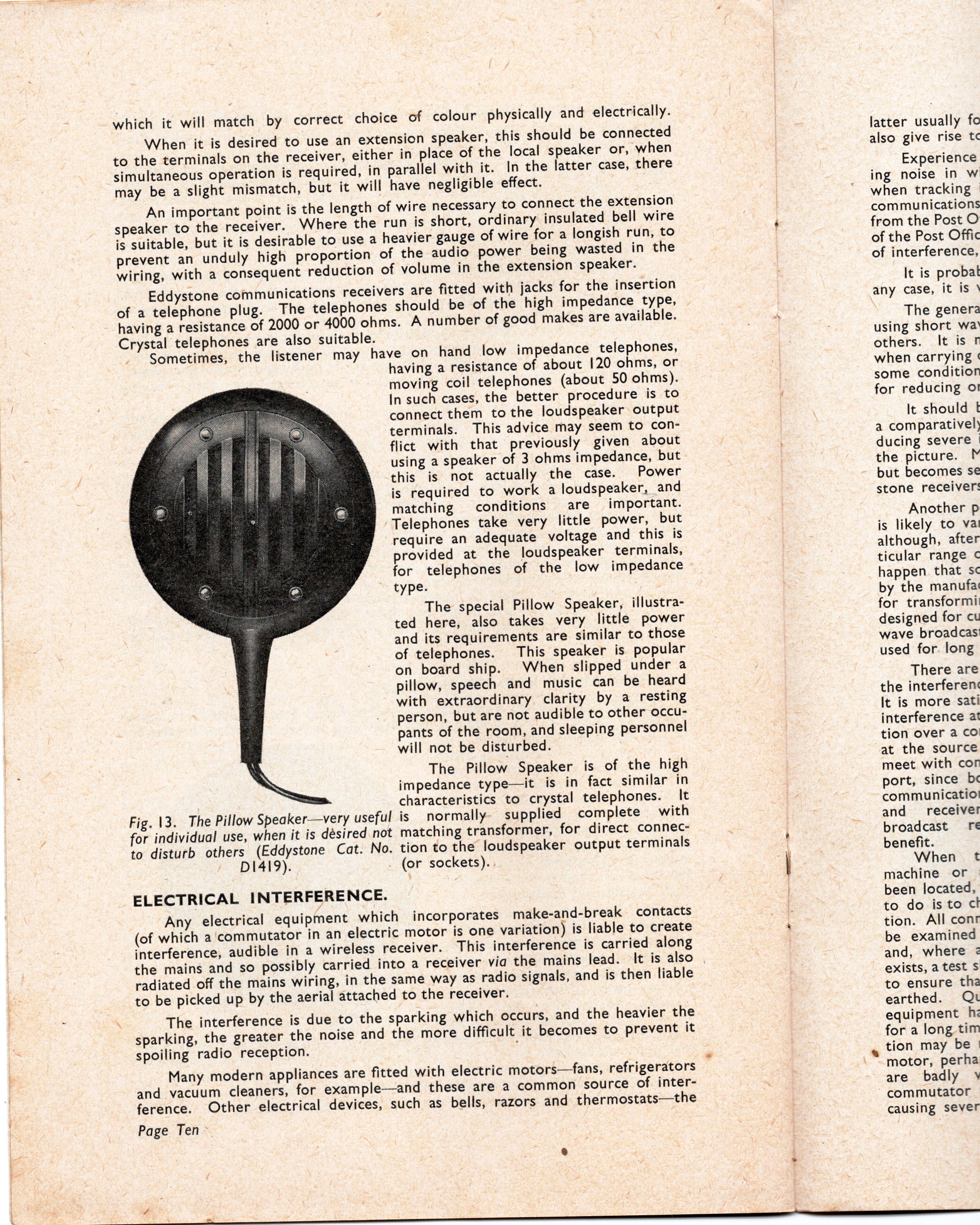
The special Pillow Speaker, illustra-
ted here, also takes very little power
and its requirements are similar to those
of telephones. This speaker is popular
on board ship. When slipped under a
pillow, speech and music can be heard
with extraordinary clarity by a resting
person, but are not audible to other occu-
pants of the room, and sleeping personnel
will not be disturbed.

The Pillow Speaker is of the high

: impedance type—it is in fact similar in

characteristics to crystal telephones. It

Fig. 13. The Pillow Speaker—very useful is normally. supplied complete with

for individual use, when it is désired not matching transformer, for direct connec-

to disturb others (Eddystone Cat. No. tion to the loudspeaker output terminals
DI419). (or sockets).

ELECTRICAL INTERFERENCE.

Any electrical equipment which incorporates make-and-break contacts
(of which a commutator in an electric motor is one variation) is liable to create
interference, audible in a wireless receiver. This interference is carried along
the mains and so possibly carried into a receiver via the mains lead. It is also
radiated off the mains wiring, in the same way as radio signals, and is then liable
to be picked up by the aerial attached to the receiver.

The interference is due to the sparking which occurs, and the heavier the
sparking, the greater the noise and the more difficult it becomes to prevent it
spoiling radio reception. :

Many modern appliances are fitted with electric motors—fans, refrigerators

and vacuum cleaners, for example—and these are a common source of inter-
ference. Other electrical devices, such as bells, razors and thermostats—the

Page Ten~

a

latter usually fo
also give rise tc

Experience
ing noise in w
when tracking
communications
from the Post O
of the Post Offic
of interference,

It is probat
any case, it is \

The genera
using short wa’
others. It is r
when carrying ¢
some condition
for reducing ol

It should |
a comparativel)
ducing severe
the picture.
but becomes sé
stone receiver:

Another p
is likely to vai
although, after
ticular range ¢
happen that sc
by the manufa
for transformi'
designed for cu
wave broadcas'
used for. long

There are
the interferen:
It is more sati
interference at
tion over a CO!
at the source
meet with cor
port, since bc
communicatio’
and receiver
broadcast ré
benefit.

When ¢
machine or
been located,
to do is to ct
tion. All conr
be examined
and, where <
exists, a test $
to ensure tha
earthed. Qt
equipment hi
for a long tim
tion may be |
motor, perha
are badly ¥
commutator
causing sever