Making the most of your receiver Eddystone Stratton VK7AG 0013
Recognised text
Text below was produced by optical character recognition and may contain errors. Check it against the original.
calling for renewals.
dirty.

If the machine is found to be in good condition bu

If other equipment, the contacts may be worn or

t still producing inter-

ference, it becomes necessary to fit a suppressor, either across the terminals of
the offending unit, or in series with them, depending on the type of suppressor
employed. The simplest takes the form of a single condenser, connected as
shown in Fig. 14. It is difficult to specify a definite value of capacity, since what
may be correct in one instance may not be entirely suitable in another. An
average value is 0. uF but other capacities between 0.01 and 0.5 uF should be
tried, if possible. Where the interference occurs on short waves, the addition
of mica condensers, having values between 0005uF and .005uF may improve

matters.

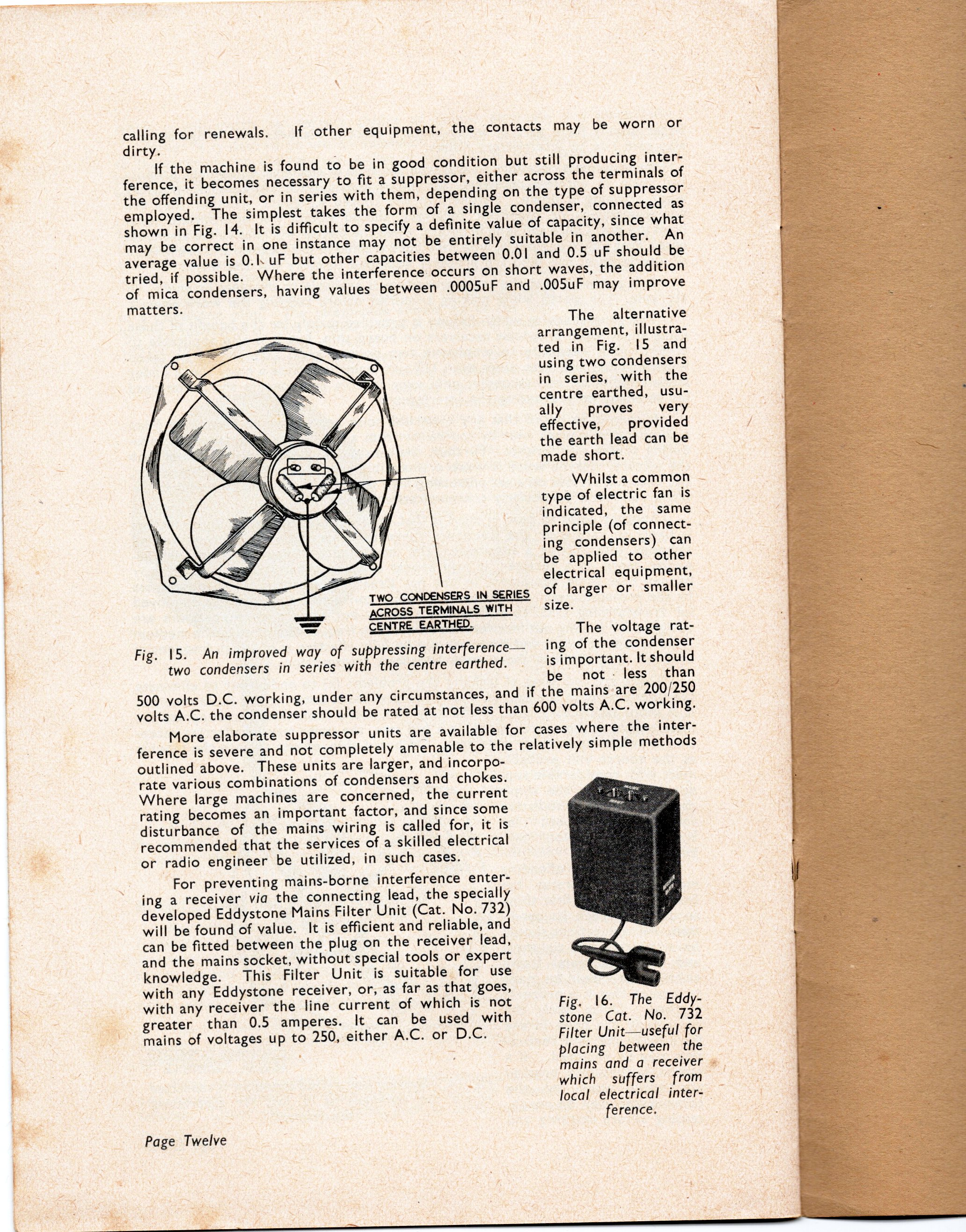
ACROSS TERMINALS WITH

—4 CENTRE EARTHED.

Fig. 15. An improved way of suppressing interference—
two condensers in series with the centre earthed.

TWO CONDENSERS IN SERIES

The alternative
arrangement, illustra-
ted in Fig. 15 and
using two condensers
in series, with the
centre earthed, usu-
ally proves very
effective, provided
the earth lead can be
made short.

Whilst a common
type of electric fan is
indicated, the same
principle (of connect-
ing condensers) can
be applied to other
electrical equipment,
of larger or smaller
size.

The voltage rat-
ing of the condenser
is important. It should
be not less than

500 volts D.C. working, under any circumstances, and if the mains are 200/250
volts A.C. the condenser should be rated at not less than 600 volts A.C. working.

More elaborate suppressor units are available for cases where the inter-
ference is severe and not completely amenable to the relatively simple methods

outlined above. These units are larger, and incorpo-
rate various combinations of condensers and chokes.
Where large machines are concerned, the current
rating becomes an important factor, and since some
disturbance of the mains wiring is called for, it is
recommended that the services of a skilled electrical
or radio engineer be utilized, in such cases.

For preventing mains-borne interference enter-
ing a receiver via the connecting lead, the specially
developed Eddystone Mains Filter Unit (Cat. No. 732)
will be found of value. It is efficient and reliable, and
can be fitted between the plug on the receiver lead,
and the mains socket, without special tools or expert
knowledge. This Filter Unit is suitable for use
with any Eddystone receiver, or, as far as that goes,
with any receiver the line current of which is not
greater than 0.5 amperes. It can be used with
mains of voltages up to 250, either A.C. or D.C.

Page Twelve

Fig. 16. The Eddy-
stone Cat. No. 732
Filter Unit—useful for
placing between the
mains and a receiver
which suffers from
local electrical inter-
ference.