Ray Allsop1
Recognised text
Text below was produced by optical character recognition and may contain errors. Check it against the original.
Raymond Allsop -

WW1 wireless

operator, engineer, FM pioneer

Raymond (Ray) Allsop is well remembered for his contribution
to the Australian sound-on-film industry and for his largely
unrequited love affair with FM broadcasting. Less well known
is the fact that he was a licensed radio amateur at 13, a
wartime shipboard operator in his teens and the inaugural
chief engineer of Australia’s first official wireless broadcasting

station.

Raymond Cottam Allsop was born on
March 11, 1898. Bitten by the prover-
bial wireless ‘bug’ at age 10, he was one
of the true industry pioneers in Austra-
lia; yet he lived long enough to glimpse
the emergence of modern-day electron-
ics in its many forms.

An enthusiast and a visionary, at least
some of his efforts in the intervening
years, through to 1972, are probably
better appreciated in retrospect than
they were when he was diligently
promoting his views to the regulatory
authorities and to industry associates.
But more about that later.

Formally educated at Sydney Gram-
mar School, Ray Allsop received his
wireless ‘baptism’, while still a school-
boy, at the hands of Father Shaw — a
controversial priest/enthusiast who set
up an experimental wireless station
(callsign XPO) at a Roman Catholic
seminary in Randwick, Sydney, not far
from the Allsop family home.

Officially responsible for the financial
affairs of the seminary, Father Shaw
combined business with pleasure and
duty(?) by gradually increasing the
scope of his wireless activities until they
culminated in the Shaw Wireless Com-
pany, complete with factory, orders,
staff and overheads — to the sometime
discomfort of church authorities.

But that is a story in itself, which was
recalled in the ‘Bright Sparks’ historical
series broadcast on ABC Radio in 1988
during the bicentenary celebrations.

It is sufficient to say that, on leaving
school in 1913, Ray Allsop was appren-
ticed to Father Shaw’s Company which
was, at the time, building Australian

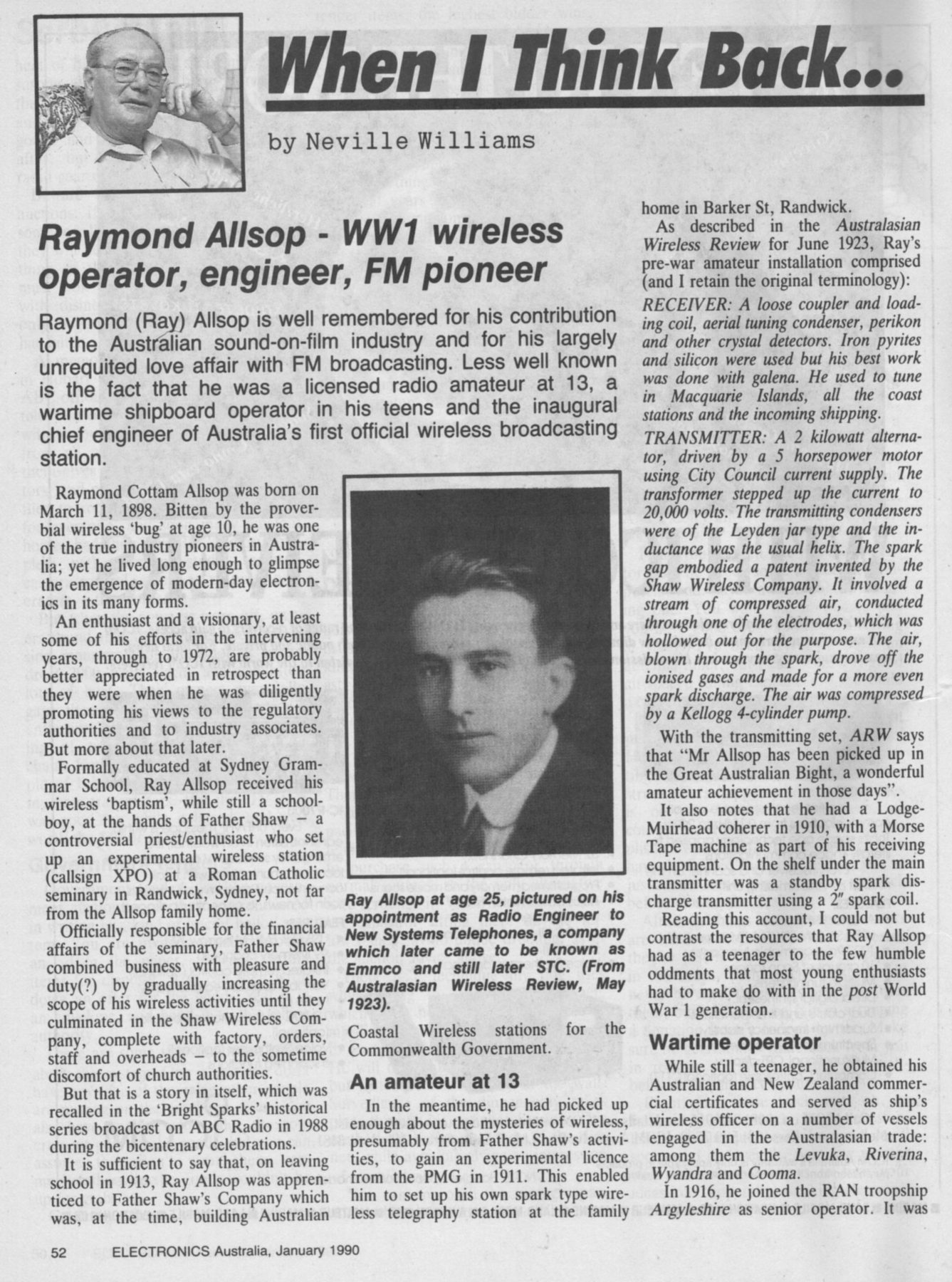
Ray Allsop at age 25, pictured on his
appointment as Radio Engineer to
New Systems Telephones, a company
which later came to be known as
Emmco and still later STC. (From
Australasian Wireless Review, May
1923).

Coastal Wireless stations for
Commonwealth Government.

the

An amateur at 13

In the meantime, he had picked up
enough about the mysteries of wireless,
presumably from. Father Shaw’s activi-
ties, to gain an experimental licence
from the PMG in 1911. This enabled
him to set up his own spark type wire-
less telegraphy station at the family

52 ELECTRONICS Australia, January 1990

When I Think Back...

by Neville Williams

home in Barker St, Randwick.

As described in the Australasian
Wireless Review for June 1923, Ray’s
pre-war amateur installation comprised
(and I retain the original terminology):

RECEIVER: A loose coupler and load-
ing coil, aerial tuning condenser, perikon
and other crystal detectors. Iron pyrites
and silicon were used but his best work
was done with galena. He used to tune
in Macquarie Islands, all the coast
stations and the incoming shipping.

TRANSMITTER: A 2 kilowatt alterna-
tor, driven by a 5 horsepower motor
using City Council current supply. The
transformer stepped up the current to
20,000 volts. The transmitting condensers
were of the Leyden jar type and the in-
ductance was the usual helix. The spark
gap embodied a patent invented by the
Shaw Wireless Company. It involved a
stream of compressed air, conducted
through one of the electrodes, which was
hollowed out for the purpose. The air,
blown through the spark, drove off the
ionised gases and made for a more even
spark discharge. The air was compressed
by a Kellogg 4-cylinder pump.

With the transmitting set, ARW says
that “Mr Allsop has been picked up in
the Great Australian Bight, a wonderful
amateur achievement in those days”.

It also notes that he had a Lodge-
Muirhead coherer in 1910, with a Morse
Tape machine as part of his receiving
equipment. On the shelf under the main
transmitter was a standby spark dis-
charge transmitter using a 2” spark coil.

Reading this account, I could not but
contrast the resources that Ray Allsop
had as a teenager to the few humble
oddments that most young enthusiasts
had to make do with in the post World
War | generation.

Wartime operator

While still a teenager, he obtained his
Australian and New Zealand commer-
cial certificates and served as ship’s
wireless officer on a number of vessels
engaged in the Australasian trade:
among them the Levuka, Riverina,
Wyandra and Cooma.

In 1916, he joined the RAN troopship
Argyleshire as senior operator. It was