Ray Allsop2
Recognised text
Text below was produced by optical character recognition and may contain errors. Check it against the original.
i ;
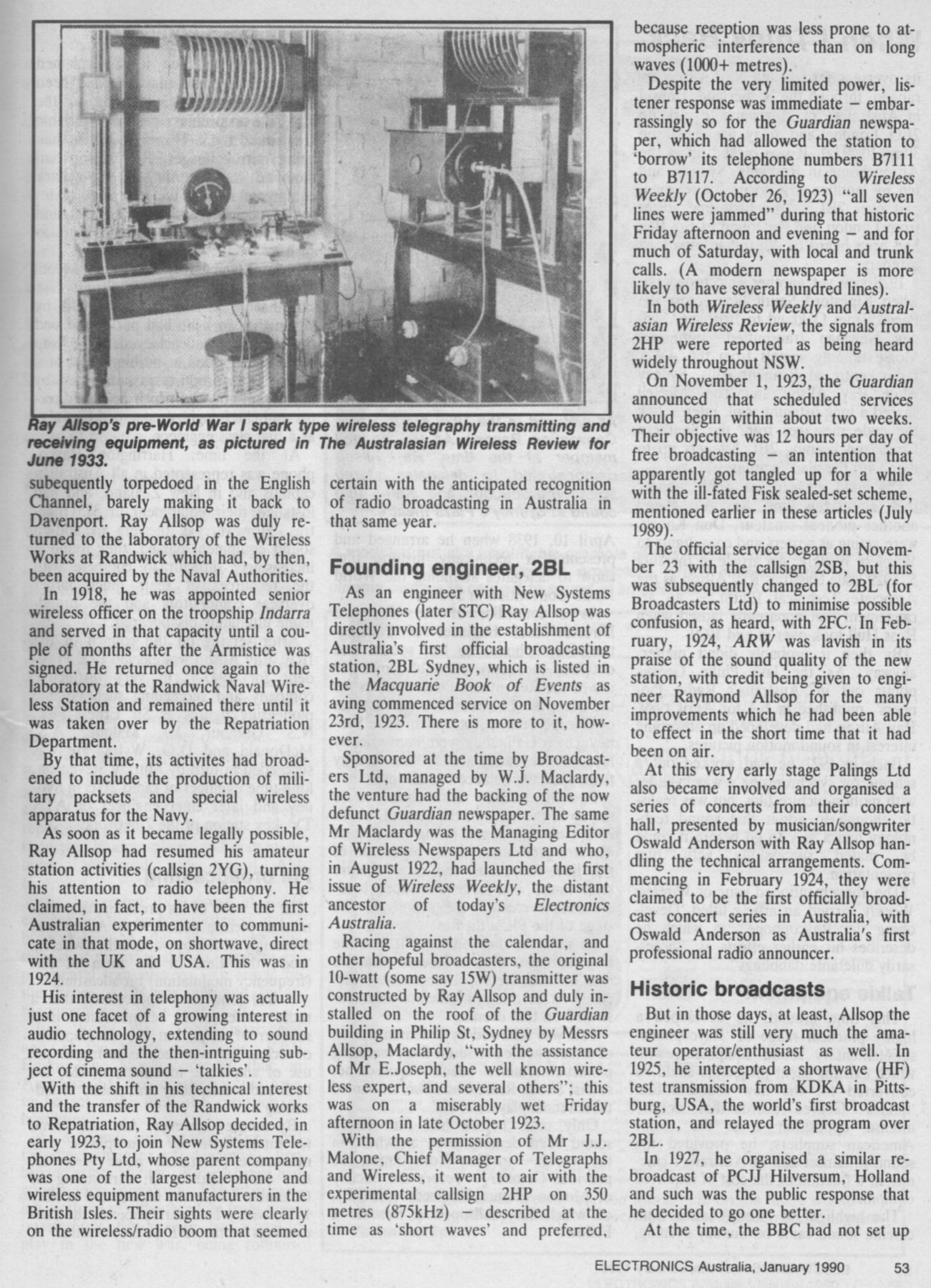
kay aikops pre-World War | spark type wireless telegraphy transmitting and

receiving equipment, as pictured in The Australasian Wireless Review for

June 1933.

subequently torpedoed in the English
Channel, barely making it back to
Davenport. Ray Allsop was duly re-
turned to the laboratory of the Wireless
Works at Randwick which had, by then,
been acquired by the Naval Authorities.

In 1918, he was appointed senior
wireless officer on the troopship Indarra
and served in that capacity until a cou-
ple of months after the Armistice was
signed. He returned once again to the
babotktory at the Randwick Naval Wire-
less Station and remained there until it
was taken over by the Repatriation
Department.

By that time, its activites had broad-
ened to include the production of mili-
tary packsets and special wireless
apparatus for the Navy.

As soon as it became legally possible,
Ray Allsop had resumed his amateur
station activities (callsign 2YG), turning
his attention to radio telephony. He
claimed, in fact, to have been the first
Australian experimenter to communi-
cate in that mode, on shortwave, direct
with the UK and USA. This was. in
1924.

His interest in telephony was actually
just one facet of a growing interest in
audio technology, extending to sound
recording and the then-intriguing sub-
ject of cinema sound — ‘talkies’.

With the shift in his technical interest
and the transfer of the Randwick works
to Repatriation, Ray Allsop decided, in
early 1923, to join New Systems Tele-
phones Pty Ltd, whose parent company
was one of the largest telephone and
wireless equipment manufacturers in the
British Isles. Their sights were clearly
on the wireless/radio boom that seemed

certain with the anticipated recognition
of radio broadcasting in Australia in
that same year.

Founding engineer, 2BL

As an engineer with New Systems
Telephones (later STC) Ray Allsop was
directly involved in the establishment of
Australia’s first official broadcasting
station, 2BL Sydney, which is listed in
the Macquarie Book of Events as
aving commenced service on November
23rd, 1923. There is more to it, how-
ever.

Sponsored at the time by Broadcast-
ers Ltd, managed by W.J. Maclardy,
the venture had the backing of the now
defunct Guardian newspaper. The same
Mr Maclardy was the Managing Editor
of Wireless Newspapers Ltd and who,
in August 1922, had launched the first
issue of Wireless Weekly, the distant
ancestor of today’s Electronics
Australia.

Racing against the calendar, and
other hopeful broadcasters, the original
10-watt (some say 15W) transmitter was
constructed by Ray Allsop and duly in-
stalled on the roof of the Guardian
building in Philip St, Sydney by Messrs
Allsop, Maclardy, ‘with the assistance
of Mr E.Joseph, the well known wire-
less expert, and several others’’; this
was on a_ miserably wet Friday
afternoon in late October 1923.

With the permission of Mr J.J.
Malone, Chief Manager of Telegraphs
and Wireless, it went to air with the
experimental callsign 2HP on 350
metres (875kHz) — described at the
time as ‘short waves’ and preferred,

because reception was less prone to at-
mospheric interference than on long
waves (1000+ metres).

Despite the very limited power, lis-
tener response was immediate — embar-
rassingly so for the Guardian newspa-
per, which had allowed the station to
‘borrow’ its telephone numbers B7111
to B7117. According to Wireless
Weekly (October 26, 1923) “‘all seven
lines were jammed” during that historic
Friday afternoon and evening — and for
much of Saturday, with local and trunk
calls. (A modern newspaper is more
likely to have several hundred lines).

In both Wireless Weekly and Austral-
asian Wireless Review, the signals from
2HP were reported as being heard
widely throughout NSW.

On November 1, 1923, the Guardian
announced that scheduled services
would begin within about two weeks.
Their objective was 12 hours per day of
free broadcasting — an intention that
apparently got tangled up for a while
with the ill-fated Fisk sealed-set scheme,
mentioned earlier in these articles (July
1989).

The official service began on Novem-
ber 23 with the callsign 2SB, but this
was subsequently changed to 2BL (for
Broadcasters Ltd) to minimise possible
confusion, as heard, with 2FC. In Feb-
ruary, 1924, ARW was lavish in its
praise of the sound quality of the new
station, with credit being given to engi-
neer Raymond Allsop for the many
improvements which he had been able
to effect in the short time that it had
been on air.

At this very early stage Palings Ltd
also became involved and organised a
series of concerts from their concert
hall, presented by musician/songwriter
Oswald Anderson with Ray Allsop han-
dling the technical arrangements. Com-
mencing in February 1924, they were
claimed to be the first officially broad-
cast concert series in Australia, with
Oswald Anderson as Australia’s first
professional radio announcer.

Historic broadcasts

But in those days, at least, Allsop the
engineer was still very much the ama-
teur operator/enthusiast as well. In
1925, he intercepted a shortwave (HF)
test transmission from KDKA in Pitts-
burg, USA, the world’s first broadcast
station, and relayed the program over
2BL.

In 1927, he organised a similar re-
broadcast of PCJJ Hilversum, Holland
and such was the public response that
he decided to go one better.

At the time, the BBC had not set up

ELECTRONICS Australia, January 1990 53